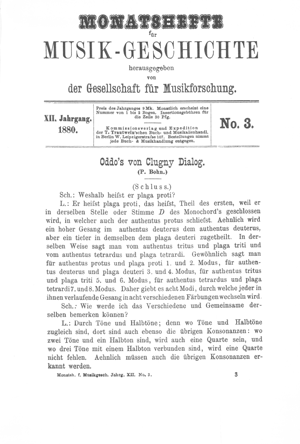
Monatshefte für Musikgeschichte
Prepared by Peter Sühring
Online only (2013)

Contents
Short Biographies of the Key Contributors
The Monatshefte für Musik-Geschichte were founded as an organ of the Gesellschaft für Musikforschung (1868-1905) by Robert Eitner and were edited by him until they were discontinued after his death (the last year was only prepared editorially). Published monthly from January 1869 to July 1905, condensed double numbers appeared extremely rarely. The final issue of 1905 (no. 7-12) contained the last articles edited by Eitner as well as additions and addendums to the directories and encyclopedias he previously published. In the first few years, Eitner edited the magazine from Berlin (where he founded the Gesellschaft) and later from Templin in the Uckermark. The magazine was published in Berlin by the Trautwein publishing house until 1884, then published, printed and distributed in Leipzig by the Breitkopf & Härtel publishing house.
The basic structure of almost all issues of the magazine was in two parts. In the first block, bibliographical and music-historical articles appeared; in the second, shorter block which concluded issues, reports of and references to events in German and international musical life and music research appeared under the title “Mitteilungen” and — usually at the beginning of this section — longer or shorter reviews. Attempts to separate the reviews from the “Mitteilungen” section were made sporadically, occasionally they were placed under the rubric “Anzeigen,” but such attempts to separate the reviews from the other components of the “Mitteilungen” with which they were often mixed were repeatedly abandoned. Sometimes isolated, longer reviews appeared among the main articles in the first part without a specific supertitle being assigned. A single issue (vol. 3 no. 5) consisted only of reviews. From January to June 1872 there was a supplement to the magazines under the title “Unsere Zeit,” in which a section entitled “Umschau” with glosses on current musical events, reviews, other communications, and music history articles, were published. Each issue contained between approximately 25 and 50 pages. All articles were printed in full-page, continuous lines. A parallel synoptic print in two columns rarely occurred ‑ usually in conjunction with translations. Initially there was advertising sporadically from music publishers and music retailers, later only self-promotion by the publishing house Breitkopf & Härtel or the editor and author Robert Eitner.
Short biographies of the editor and key collaborators and their significant contributions
Editor:
Robert Eitner (1832-1905)
He began his professional career as a music teacher but felt uneasy about the insufficient sources to provide historically informed lessons. To remedy this situation, he and a group of like-minded individuals founded the Gesellschaft für Musikforschung (Society for Music Research) in Berlin in 1868. Its main purpose was to improve resources through bibliographic and biographical research in order to create a foundation for an assessment of music history in its entirety that is based on the real development of music. The results of this research were then published continuously from 1869 onwards in the society's organ, the Monatshefte für Musikgeschichte. Eitner was the only secretary of the society, functioning alongside a temporary executive committee or board (not permanent bodies), and he was the only editor of the journal for the entire 37 years of its publication.
Eitner also provided research reports, written by himself, with extensive bibliographic descriptions of sources and lists of manuscripts and prints of older music stored in libraries and private collections. He placed a focus on recording and evaluating the song collections that were particularly important for the emergence of German music, as well as the early pure instrumental music as an echo of developments in Italy. He also took part in the evaluation and qualitative-aesthetic assessment of these sources he and others found with his own contributions.
Eitner was the main author of most of the journal's issues; he signed his articles either with his full name or with a variety of abbreviations, and all of the unsigned articles, some of which were written in the first person, were also written by him. He occasionally published monographic articles about individual composers whose lives and works he had researched. Every year he gave a financial report in which he balanced the financing of the magazine according to income and expenses. He published organizational and technical notices and information concerning the society, such as information about meetings of the committee or board (consisting of six Berlin members with Franz Commer as chairman) and rarely held general meetings (until 1887); as well as receipts for contributions paid by the members; and information about the subscription to the magazine and other publications of the society.
Adolf Auberlen (1834-1902) was a Württemberg pastor who was particularly interested in and committed to hymn research. He propagated the task of publishing sources for a better understanding of music history (in the supplement “Unsere Zeit” from April 1872) and published an individual music-historical study of Michael Altenburg in the MMG (XI,11).
Wilhelm Baeumker (Bäumker) (1842-1905) was a Catholic theologian and hymnologist. In addition to his services in Rhineland parishes, he dedicated himself to collecting and presenting the melodies of Catholic church singing and profane folk singing. He wrote in the MMG Representations of polyphonic music at the Council of Trent (IX, 6/7), the dispute over the birth year of Pierluigi da Palestrina (IX,10), the conflicts of minstrels with the ecclesiastical authorities (XII,7), the history of folk song melodies (XVI,3 and 8), the history of polyphonic folk singing (XVII,3), the dispute over the creation of pure Luther melody (XIX,5) and he published a translation of a counterpoint instruction from the 16th century (X,5) as well as several smaller historical sketches.
Georg Becker (1834-1928) was a composer and musicological writer who had lived in Geneva since 1865 and who mainly dealt with Swiss music history. For the MMG he wrote a chronology of the editions of the Geneva Psalter (II,8), cultural-historical sketches from Romanesque Switzerland (X,10), and published rare bibliographic descriptions in several issues from the 1870s and 80s under the title “Aus meiner Bibliothek.” Manuscripts and prints as well as a number of shorter historical sketches, especially about the early melodicists of the French psalms, and published the original French version of the treatise Nouvelle et facile méthode pour chanter by Pierre Davantes (I,11).
Wilhelm Bode (?-1900) was a hymnologist who taught at the school teachers' seminar in Lüneburg. For the MMG he wrote articles about the melody in church hymn books (IV, 11), the church melodies of Johann Crüger (V,4 and 5), the origin of the melody “Herzlich lieb hab ich dich, o Herr” (V,8), the singing tunes from the Lüneburg Hymnal (XIV,3 and 4), as well as smaller historical sketches and reviews.
Theodor Böttcher (?-1877) was a private collector of portraits of musicians and other art objects living in Bad Cannstatt and evaluated them biographically. In the MMG he gave insights into his collections of portraits of musicians (in the supplement “Unsere Zeit” from April 1872 and VIII,5), biographical notes on Caspar Othmayr (VIII,4) and wrote about readable music illustrations on portraits of musicians (VIII,10).
Emil Bohn (1839-1909) was a church musician, choir director and music writer who worked in Breslau (Wroclaw). He organized exemplary historical concerts and cataloged the music holdings of the Breslau libraries. For the MMG he wrote a bibliographical sketch about the Breslau holdings of Philipp Friedrich Buchner (XIII, 10).
Peter Bohn (1833-1925) was a high school teacher, church music historian and Gregorian scholar who worked in Trier. In the MMG he published investigations of individual finds in Trier libraries: a lamentation of the Virgin Mary from the 15th century and the Low German play Theophilus (both in IX,1), a biographical sketch about Nicolaus Wollick from Serovilla (IX,3), reports of the different wording in a Trier copy of the tonarium by Berno (IX, 10) and the dialogue by Oddo (XII, 2), an article on the liturgical recitative and its name in the liturgical books of the Middle Ages (XIX, 3-5), a biographical sketch by Philippe de Vitry, including a copy and translation of his writing Ars nova with explanations (XXII, 8/9), an article about the plica in Gregorian chant and mensural chant (XXVII, 4), about a Trier song manuscript from the end of the 15th century until the beginning of the 16th century (XXIX,3), on the Gregorian chant, its origin and development of musical notation (XXXIV, 5 and 6), and several smaller historical sketches and several reviews.
Michel Brenet (Pseudonym for Marie Bobillier) (1858-1918) was a French female music historian who published under a male pseudonym (in order to be noticed at the time) and who, with groundbreaking research, broke through established conventions, refuted false assumptions and shed light on dark areas in historiography.[2] In the MMG she published about the origin and shape of the melody of “L'Homme armé” (XXX.10) and about the concert system in France under the ançien régime in the form of a translation and summary of her book of the same title by Eitner (XXXII.10). Shortly before Eitner's death, he received the first indications, which he found completely unbelievable, that Michel Brenet, whom he admired, was a woman.
Franz Commer (1813-87) was a church musician, choir director, singing teacher, lecturer, composer and extremely productive editor of older music who worked in Cologne and Berlin. Co-founder of Eitner’s Gesellschaft für Musikfoschung, his pro forma position as chairman was not replaced after his death. In the MMG, some of his editions were criticized by Eitner, especially because of his lack of understanding of the old codes; otherwise Commer only took part in announcing the financial balance of the monthly magazines.
Wilhelm Crecelius (1828-89) was a historian, linguist and high school teacher in the Bergisches Land who published three shorter sketches on linguistic history, organology and biography in the MMG in the 1880s.
Henry Davey (1853-1929) was a British musicologist and pianist who published a much-discussed History of English Music in 1895. In the MMG he published a series of articles about the oldest music manuscripts in English libraries in volume XXXIV (1902) and in the 1890s he had a controversy with Wilibald Nagel about his own history of music in England.
Theodor Distel (1849-1912) was a music-loving legal historian, archivist, and local Dresden historian. For the MMG he wrote numerous short messages about library holdings he had discovered in Dresden archives, some biographical sketches and corrections on isolated music-historical circumstances, in particular a report on passages relating to music in two manuscripts by the Electoral Saxon theater director Joseph Friedrich von Racknitz (XXIV,9) that were found in the main state archive.
Alfred Dörffel (1821-1905) was a music writer, editor and critic as well as a librarian in Leipzig. He wrote a history of the Leipzig Gewandhaus concerts and for the MMG he published an early treatise on the oldest products of German musical art, i.e. the medieval song collections (I,4) and a biographical and work-historical study of the monastic song composer Laurentius von Schnüffis with additions by Eitner (II,6).
Ottmar Dressler (1834-85) was a Württemberg church musician, organist, choir director and composer. For the MMG he wrote a biographical study about the Weingarten monastery musician Jakob Reiner (III,7) and a work analysis of Reiner's five or four-part Passion (V,11 and 12).
Hermann Ludwig Eichborn (1847-1918) was a musician (brass instruments), composer and music writer (instrument historian) who worked in Breslau and South Tyrol. In the MMG he wrote a fundamental article under the title “Neue Strömung in der Tonkunst” (XVI, 1), in which, on the one hand, he doubted the content of the latest musical developments, and on the other hand, he advocated the most authentic performance as possible of early music, especially that before Bach. He wrote several organological articles on the inclusion of the horn into art music (XXI,5), on discantus, fauxbourdon and treble (XXI,10), on the question of the treble (XXII,4), about Girolamo Fantini, a virtuoso of the seventeenth century and his trumpet school (XXII,7), and studies on the history of military music (XXIV,6/7).
H. Fischer (?-?) was a local historian in Königsberg who particularly worked on and edited poetry and music of the 17th century. He published biographical sketches in the MMG about Johannes Stobaeus (XV,6 and XVI,8), Johann Weichmann (XV,6), Christoph Kaldenbach (XV,8) and Heinrich Albert (XVI,8).
Adolf Frölich (?-?) was a Swiss priest who researched song lyrics and melodies. For the MMG he wrote essays on the extra-church song lyrics of the 16th century (VII, 7 and 8) and he translated the Deploration on the death of Johann Okeghem from Old French (XI, 3).
Ludvig Fökövi (1852-1900) was a piano teacher and historian of Hungarian music working in the city of Szeged. For the MMG he wrote a depiction of the music and musicians at the court of Gabriel Bethlens (XXX.3) and the gypsy music in Hungary (XXX.12).
Moritz Fürstenau (1824-89) was a flautist, music historian and librarian who worked in Dresden, a member of the Staatskapelle and founder of the Tonkünstler Association. For the MMG he wrote articles on Don Juan literature (II,3), on the order of royal services in the 17th century (III,4), on the performance of Gluck's Orpheus in Munich in 1773 (IV,11), on the Collection of musical instruments in Venice (VI,7), about the royal music collection in Dresden (X,9), a biographical sketch about Maria Antonia Walpurgis, Elector of Saxony (XI,10), a report on the opera Antiope and the appointment of the Electoral Saxon Vice-Kapellmeister Nicolaus Adam Strunck and the court poet Stefano Pallavicini (XIII,1) and a number of shorter historical and biographical sketches. He was a role model in the creation of bibliographic directories of Dresden library holdings and promoted the related activities of the Society for Music Research for other cities.
Hugo Goldschmidt (1859-1920) was a musicologist who undertook fundamental and important research into Italian vocal technique and opera history and published reference works on these questions. He undertook the first edition of Monteverdi's opera L'Incoronazione di Poppea. For the MMG he wrote: Ornaments, changes and passages in the 16th and 17th centuries and their musical significance, discussed according to two previously unknown sources (XXIII,7), Cavalli as a dramatic composer (XXV,3 and 4/5/6), the instrumental accompaniment of Italian musical dramas in the first half of the 17th century (XXVII, 4 and 5), and on the history of aria and symphonic forms (XXXIII,4/5).
Franz Xaver Haberl (1840-1910) was a Catholic church musician and church music historian who studied sources in the Biblioteca Vaticana in Rome, published the works of Pierluigi da Palestrina and Orlando di Lasso and the church music yearbook. He founded the Catholic church music school in Regensburg. In the MMG he published on the masses of Adrian Willaert, printed by Marcolini da Forli (III,6), a bibliographic-critical study on Matthias Hermann Werrecorensis (III,12 and IV,1), a description of the Cod. Mscr. No. 98th. from the Proske library in Regensburg (IV,8) and prints by Ottaviano Petrucci at the library of the Liceo filharmonico in Bologna (V,4 and 6).
Richard Hohenemser (1870-1942) was a music writer born in Frankfurt/Main into a Jewish family, lived in Frankfurt/Main and Berlin without a university position after his musicological training (in Berlin with Spitta, Bellermann and Fleischer and in Munich with Sandberger), wrote several books and essays. He committed suicide with his wife in 1942 to avoid deportation. In the MMG he published a longer study of J. K. F. Fischer as a piano and organ composer (XXXIV, 9-11).
August Horneffer (1875-1955) was a philologist, philosopher and musicologist who later joined Freemasonry. Following his Berlin dissertation on Johann Rosenmüller, he published his biographical sketch (XXX,8) and a list of Rosenmüller's works (XXXI,3-5) in the MMG.
Otto Kade (1819-1900) was an extremely productive, source-oriented musicologist and librarian who worked first in Dresden and then in Schwerin as grand ducal music director in Mecklenburg. He cataloged the court orchestra's extensive music collection. Co-founder of the Monatshefte and one of its most frequent authors, he was a close colleague of Eitner. Kade wrote for the MMG: Leonhard Lechner and his dispute with Count Eitel Friedrich von Hohenzollern in 1585, a picture of culture and character from the 16th century (I,11 and 12), Rogier Michael, a German composer of the 16th century (II,1), explanations and explanations of the content of the anthology Contrapunctus 1528 (II,7), Johann Oyart of Cologne, senior 1524-1550, Johann Oyart of Cologne, junior, 1550-15 (III,1), commentary on the print of the report by Gottfried Fritsch about the new organ in the castle church in Dresden in 1612 (III,6), two archival documents from the 16th century (IV, 3), a previously unknown Protestant hymn book from 1531 (IV, 6 and 7), corrections to the Locheimer song book from 1450 (IV, 12), about the actual melodic body of the song “Inspruck ich muss dich alles” by Heinrich Isaac (V,6), addendum to Caspar Othmayr (VIII,1), again the musical treasures of the 15th to 17th centuries at the Rathsschule Library in Zwickau (VIII,2), Thomas Stoltzer's Psalm “Noli aemulari”, 6 voci: an art-historical contribution (VIII, 11 and 12), a handwritten codex in the Magliabechiana Library in Florence (IX, 2), two unknown German sacred songs from the 16th century (X, 5), Samuel Scheidt and his dedication text when presenting his organ tablature book to the Elector of Saxony Johann Georg I in 1624 (X,11), review by A. W. Ambros, History of Music, Fourth Volume, Fragment (XI,1), Master Anthonius, organ builder in Dresden, 1477 (XI,12), the order of the Spelelude (Joculatorum) from Wismar in 1343 (XIV,7), an isolated treble part from 1573 with printed works from 1568 and 1572 in the library of the cathedral school in Güstrow (XV,11), biographical information on Antonio Squarcialupi, the Florentine organist in the 15th century (XVII, 1 and 2), description of the printed works and manuscripts among the older music materials of the city of Freiberg in Saxony (edited and commented on by his son Reinhard Kade, a supplement to the Monatshefte), a catalog of the royal music collection in the Dresden public library (together with Eitner, supplement to the Monatshefte), Adrian Petit Coclicus (1500-1555/56): a contribution to the music history of the 16th century (XXIX, 1 and 2), Abraham Praetorius, a Mecklenburg composer three hundred years ago: posthumous work (XXXIII,1) and several small sketches.
Reinhard Kade (1859-1936) was a musicologist and senior teacher working in Dresden. For the MMG he wrote: Contribution to Cantor Doles (XX.1), the Dresden Kapellmeister Johannes Baptista Pinellus (XXI.9 and 10), obituary for his father Otto Kade (XXXII.9), and a number of smaller sketches and reviews.
Alfred Christian (Christlieb) Kalischer (1842-1909) was a classical philologist, music historian and cultural-political journalist who came from a rabbinical family. In addition to working on religious and political philosophical writings, he worked as a Beethoven researcher and was the editor of the first critical edition of his letters. For the MMG he wrote a ten-part series of articles about the Beethoven autographs in the Royal Library in Berlin (XXVII, 10-XXVIII, 7).
Oswald Koller (1852-1910) was a historian and German scholar, as a music researcher he was self-taught and yet became a pioneer of musical medieval studies; as an employee of Guido Adler, he became co-editor of the Denkmäler der Tonkunst in Österreich and librarian of the musicology library at the University of Vienna. In the MMG he published: from the archive of the Benedictine monastery of St. Paul in Lavanttal in Carinthia (XXII, 2 and 3) and together with Adler corrective comments by the editors of the edition of the Trent codices on their review in the monthly magazines (XXXII, 10 ).
Arthur Kopp (1860-1918) was a song researcher and librarian who worked in Berlin and Marburg. He appeared in the MMG as an author in connection with the Berlin song collections and published: a handwritten song collection from the Royal Library in Berlin (XXXI, 5-7), as well as a note on the printed edition of the songs by Adam Krieger (XXXII,9).
Otto (Utto, Joseph) Kornmüller (1824-1907) was a Catholic (Benedictine) church music historian and practical church musician working in Metten with a focus on researching medieval music. In the MMG he published biographical sketches on Georg Muffat as well as Cajetan Kolberer and Nonnosus Madlseder (III,8), a longer treatise on the theory of chorale composition from the 10th to the 13th century (IV,4 and 5) and on the musical alphabet (X, 7).
Rochus von Liliencron (1820-1912) was a philologist, historian and folk song researcher, editor of the Allgemeine Deutsche Biographie, the monuments of German music and historical folk song collections. For the MMG he wrote: a manuscript collection of songs from the 17th century (XXIII,8), and an old Sapphic melody (XXIX,2).
Karl Lüstner (1834-1906) was a cellist and piano teacher, worked in Wiesbaden, provided Hugo Riemann with many notes for his lexicon, supported Eitner with preparatory work for his source lexicon and compiled the annual obituary list in the MMG.
Josef Müller (?-1881) According to Chysander, he was editor of the Allgemeine Musikalische Zeitung in Leipzig from 1871-74 and initially worked with Eitner breaking with him and legal disputes. Müller opened a small series: contributions to the literature and history of music (II,1 and 3) and was named as a signatory of the call for German libraries to save Otto Jahn's legacy library (together with Eitner and O. Kade, II,1 ). At the end of the fourth year (1872), Eitner's conflict with Müller escalated, who had accused Eitner of using the Gesellschaft and the Monatshefte for private interests. In a statement dated December 31, 1872 (V,1), Eitner emphasized that renowned experts in individual areas were committed to the magazine and that there was no concentration on himself as editor. In particular, the Monatshefte were not a commercial enterprise with profit intentions.
Willibald Nagel (1863-1929) was an extremely productive and controversial musicologist, music critic and choir director who worked in Zurich, Darmstadt and Stuttgart and was dedicated, among other things, to Swiss and English music history. He studied for two years in England and made contributions to Mozart, Beethoven, and Brahms scholarship, and was a fierce critic of modernism. In the MMG he published: the choirs from Philargyrus by Petrus Dasypodius (XXI,7), the music in the Swiss dramas of the 16th century (XXII,5), explanations on the Fundamentum by Johann Buchner (XXIII,5/ 6), to the text reproduced in German translation by John Dowland's Necessairie Observations belonging to Lyte-playing (XXIII,9), The Nuremberg Music Society (1588-1629) (XXVII,1), annals of English court music from the time of Henry VIII to death of Charles I (1509-1649), according to the original documents (supplement to volume XXVI), on the history of English court music, from the restoration of the monarchy to the beginning of the 18th century (ibid.), Gilles Heine (XXVIII, 8 and 9), the Kantoreigesellschaft zu Pirna (XXVIII, 11 and 12), on the biography of Joh. Staden and his sons (XXIX, 4), miscellanea on J. J. Quantz and the Dresden city pipers (XXIX,5), a dialogue by John Hilton (XXIX,8 and 9), a piece of old English parodic music (XXX,4), Daniel Purcell (XXX,5), on the history of music at the Court of Darmstadt (XXXII, 1- 5).
Albert Quantz (1837-91) was a composer and bibliographer. For the MMG he wrote: on portraits of musicians (VII,6), Johann Jeep (VIII,4), on the œuvres de Frédérick le Grand (IX,2), the musical works of the Royal University Library in Göttingen (catalog, supplement to the XVth year of the MMG), and a number of bibliographical references.
Bernhard Friedrich Richter (1850-1931) was a protestant church musician working in Leipzig who published the results of his Bach research primarily in the Bach yearbook. For the MMG he wrote: Johann Sebastian Bach and the University of Leipzig (XXXIII,7), two funeral programs for the St. Thomas cantors Sebastian Knüpfer and Joh. Schelle (XXXIII,12 and XXXIV,1), explanations of a treatise by Johann Kuhnau (XXXIV,9), and a list of Johann Kuhnau’s church music from the years 1707-1721 (XXXIV, 10).
Julius Richter (?-?) In the MMG he published: a twenty-four-part psalm by Jacob Handl (XI, 4), music for two discovered passions (XI, 5 and 6), the Spiritual Dialogues by Rudolph Ahle (XII, 4 and 5), Hommel's Psalter (XII, 11 and 12), two writings by Conrad von Zabern (XX, 4 and 7), and a catalog of the music collection at the University Library in Basel (supplement to the year XXIII).
Hugo Riemann (1849-1919) was a famous music historian, theorist and lexicographer whose definitions and schemas were authoritative for a long time. In the MMG he also offered solutions to some of the questions that were still before him: about Zarlino as a harmonic dualist (XII,10), the different meanings of color (blackening) in the mensural notations of the 16th century (XX,10), when the suite came into being (XXVI,7), and the lute work of Miguel de Fuenllana (XXVII,6).
Ferdinand Wilhelm Emil Roth (1853-1924) was a self-taught historian and archivist. For the MMG he wrote: contributions to the music literature of the Middle Ages and modern times (XX.4), music manuscripts from the Darmstadt Court Library (XX.5 and 6), on the bibliography of the music prints of the XV. to XVII. century in the Darmstadt Court Library (XX.8-10), on the bibliography of the music prints of the XVI. XVIII. century in the Mainz city library (XXI, 2), from older musical works (psalm books and responsories) (XXV, 3) and a number of shorter bibliographic notes.
Julius Rühlmann (1816-77) was an organologist and music writer. In the MMG he published on Gottfried Silbermann and his cimbal d'amour (II,8 and 9), and the founding of an instrument museum (V,1).
Paul Runge (?-?) was a medieval researcher and editor of medieval song manuscripts with controversial views. He published for the MMG: the discussion of the Colmar singing tunes by Dr. Heinrich Rietsch in Vienna (supplement to issue 12 of the XXXth year), response to accusations made in a review by Oskar Fleischer against Runge's edition of the Geißlerlieder (XXXIII,1), the Minnegesang and its lecture (XXXV,6), music as auxiliary science of philology in relation to the medieval song (XXXVI,1), the notations of the Somanātha (XXXVI,3/4) as well as some reviews in connection with questions of song edition.
Raymund Schlecht (1811-91) was a very productive music historian and chorale researcher who worked in Eichstätt. In the MMG he published about the oldest piano literature (II,7), music history from the beginning of the 16th century, according to the Mirror of Organ Makers and Organists by Arnold Schlick, 1511 (II,10-12), about pitch and notation of compositions from the 15th and 16th centuries (III,8), report on the work of the general German Cäcilienverein in general and on its third general assembly in Eichstätt (supplement “Unsere Zeit” in November 1871), attempt at a critical clarification of the chapter X in the Micrologus by Guido of Arezzo (IV, 7), biographical communications about Anton Cajetan Adlgasser (together with P. Sigismund Keller, V, 3), a German translation of the Micrologus by Guido von Arezzo with explanatory additives (V, 9-11), Musica Enchiriadis by Hucbald, translated and accompanied by critical notes (VI,11-VII,4) comments on Hucbald's Musica enchiriadis (VII,4-6), review of The Fall and Lamentation of the Virgin Mary, two low German plays (VII, 9 and 10), subsequent comments on the translation and explanation of the Musica Enchiriadis by Hucbald (VIII, 8), on the use of diësis in the 13th and 15th centuries based on translation and explanation of treatises by Prosdocimus de Beldemandis (IX, 4 and 5), report on Albert von Thimus, the harmonic symbolism of antiquity, second section (X,1), translation and commentary on Hermann Finck's writing on the art of singing (XI,8 and 9), the old keys and modern music (XII,3 and 4), on tonal relationships (XIII,2 and 3), archival studies in the Eichstätt archive in Bavaria (XV, 2 and 3), and the modern Greek tonal families (XVI, 6 and 7).
Hans Michael Schletterer (1824-93) was a conductor, composer, and music historian who worked mainly in Augsburg and concentrated his historical research on Augsburg and Romanesque countries and was the author of the first biography of Reichardt. In MMG he published a catalog of the musical works in the district and city library, the municipal archive and the library of the historical association in Augsburg (X,12), excerpts with explanations from Grimm's Correspondance littéraire concerning the musical history of France (XIV,8), the opera houses of Naples (XIV,11-V,1), Translation of an article about the opera by Jacques Bernard Durey de Noinville (XV,7), Sigmund Salminger (XXI,11), musical competitions and music festivals in the 16th century (XXII,10 and 11), and posthumously: file material from the municipal archive in Augsburg (XXV, 1).
Eugen Schmitz (1882-1959) was a music historian and critic who worked in Leipzig and adapted to all external political conditions. At the beginning of his academic career, he wrote studies on guitar tablatures (XXXV,9), studies on P. Torri's oratorio La Vanità del mondo (XXXVI,1 and 2), and studies on W. C. Printz as a music writer (XXXVI,6/7) for the MMG.
Anselm Schubiger (1815-88) was a Benedictine church musician, music historian and composer who lived and worked in the Einsiedeln monastery. For the MMG he wrote: historical errors in the field of music (I,9), Carlo Donato Cossoni (III,4), on the five or four-part Passion by Jakob Reiner (IV,11), on Hucbald's work De Musica (X, 2) as well as several shorter historical sketches and notes.
Ludwig Sieber (1833-91) was a high school teacher and senior librarian at the university library who worked in Basel and was committed to modern cataloging and expansion of the collections. In the MMG he published Gaspar Otmaier's epitaph to Dr. Martin Luther (VIII,1) as well as other shorter historical sketches and notes.
Josef Sittard (1846-1903) was a music educator, historian and critic who worked in Stuttgart and Hamburg. For the MMG he wrote: Reinhart Keiser in Württemberg (XVIII,1), published the confirmation of Duke Ulrich von Württemberg for the Society of “Trompeter, Pfeiffer und Lautenschläger“ (XIX,1) as well as other shorter historical sketches and notes.
Hans Sommer (1837-1922) was a composer, music historian (Schürmann researcher) and concert organizer who worked in Berlin, Weimar and Braunschweig. For the MMG he wrote: the opera Ludwig the Pious by Georg Caspar Schürmann (XIV, 2 and 3), and Schürmann's opera Ludovicus Pius (XXIV, 9).
Philipp Spitta (1841-94) was a classical philologist and music historian (Bach researcher) and editor. In the MMG he published music documentary miscellaneous (II,4), more about Joachim von Burck (II,10), and funeral sermons on musicians of the 16th century and 17th century (III,2/3).
William Barclay Squire (1855-1927) was a music librarian (head of the music department at the British Museum in London 1885-1920) and critic. For the MMG he wrote a number of shorter bibliographic descriptions of library holdings as well as on unknown music collections in the British Museum (XXII,12), Petrucci's Motetti de Passione (XXVII,5), and a music catalog of the library of Westminster Abbey in London (supplement to the monthly magazines, volume XXXV).
Reinhold Starke (1850-1904) was a music historian working in Breslau. For the MMG he wrote: Hieronymus Gregorius Langius Havelbergensis (XXXI, 7 and 8), Tobias Zeutschner (XXXII, 11 and 12), Biography of Samuel Besler (XXXIII, 9 and 10), Ambrosius Profe (XXXIV, 11 and 12), the organ works from the church of St. Elisabet in Wroclaw (XXXV, 2 and 3), Cantors and organists from the church of St. Mary Magdalene in Wroclaw (XXXVI, 5 and 6/7), Johannes Nuc (Nucis or Nucius) (XXXVI, 12).
Carl Stiehl (1826-1911) was an organist, choir and orchestra conductor and music librarian who trained in Leipzig and worked in Jever and Lübeck. In the MMG he wrote bibliographic descriptions of Lübeck library holdings (XVI,11), Franz Tunder, born 1641, died 1667, Nov. 5, as organist at St. Mary's Church in Lübeck (XVIII,12), Thomas Baltzar. 1630-1663: a Paganini of his time (XX,1), the Düben family and the Buxtehude manuscripts in the Upsala Library (XXI,1) as well as smaller historical sketches and notes.
Wilhelm Tappert (1830-1907) was a music educator, critic, writer and composer, specialist in the lute. For the MMG he wrote On the History of the Guitar (XIV,5), Philipp Hainshofer's Lute Books (XVII,4), the Lute Books of Hans Gerle (XVIII,11), to Baden under the hot stone (XXII,11), The Well-Tempered Clavier (XXXI, 8 and 9), Esajas Reusner, the Great Elector's chamber lutenist (XXXII, 8), and the Minuita - not a minuet! (XXXIII,6).
Gerhard Tischer (1877-1959) was a music publisher and writer who began his journalistic career around 1900 with reviews for the MMG: A. Gevaert and J. C. Vollgraff, Les Problèmes musicaux d'Aristote, Richard von Kralik, Ancient Greek music, Hector Berlioz, Letters to Carolyne Sayn-Wittgenstein, La Mara, Letters from outstanding contemporaries to Franz Liszt, Volume III; he also wrote the music catalog of the main church in Sorau/Niederlausitz (supplement to the monthly magazines for the XXXIVth year, together with K. Burchard) as well as the obituary for Robert Eitner (XXXVII, 4).
Caroline Valentin (1855-1923) was a female musicologist and journalist working in Frankfurt/Main who wrote a history of music in Frankfurt and a number of specialist articles in magazines and newspapers. She wrote for the MMG: Mozart letters from the Donaueschinger library, communicated and explained (XXXI, 2 and 3), two Beethoven letters from the Donaueschinger library (XXXI, 9), music bibliography from Frankfurt a. M. (XXXIII,11 and 12, XXXIV,1 and 2).
Franz Waldner (1843-1917) was a South Tyrolean historian and music critic. In the MMG he published: Petrus Tritonius and the oldest printed Catholic hymn book (XXVII, 2), news about the cultivation of music at the court in Innsbruck based on archival records under Emperor Maximilian I from 1490-1519: a contribution to Tyrolean cultural history (supplement to the XXIXth year of the Monatshefte), and news about the cultivation of music at the court of Innsbruck under Archduke Ferdinand 1567-1595 (XXXVI, 9-11).
Joseph Wilhelm von Wasielewski (1822-96) was a violinist, conductor and music historian with a focus on instrument history (violin and cello) and biography (Schumann and Beethoven). He wrote the following articles for the MMG: a French music report from the first half of the 17th century (André Maugras, Rome 1639) communicated and introduced in German translation (X, 1 and 2), obituary for the deceased librarian of the Liceo comunale di musica in Bologna, Gaetano Gaspari (XIII,4/5/6), Gaspard Duiffoprugcar (XV,4), excerpts from L'Estat de la France relating to the years 1661, 1663 and 1665 (XXI,8) as well as smaller sketches and reviews.
Franz (Xaver) Witt (1834-88) was a reform-minded Catholic church musician in Regensburg, founder and leader of the Cecilia Association. He wrote for the MMG: Hanns Leo Hasler: preparatory work for a monograph about this master (I,1), song texts from the 16th century and their composition by Hanns Leo Hasler, Orlandus Lassus and others. (II,2), short notes on the way to re-edit old works (III,2/3), and commentary overview of the content of the various series and deliveries of the Trésor Musical (VI,6 and 7).
The main purpose of the Monatshefte was to continuously publish the results of the collecting and research activities of the members of the Gesellschaft für Musikforschung and of its friends or corresponding authors, for mutual understanding and instruction, as well as to influence the reading public interested in music history and music practice. The Monatshefte particularly cultivated the form of initial bibliographic description of library holdings developed and required by editor Eitner, with details of the full title, format, call number, publisher and printing place, year of publication and scope. In the case of anthologies, the individual works were also required to be listed precisely by author and title. In the case of manuscripts, information about the scribes and the notation form was required wherever possible. The constant calls to provide such descriptions of library holdings and those in church and city archives and to improve their formulation were followed in large part and led to extensive directories and catalogs over the course of the years. But the evaluation of this source, music-historical classifications and qualitative determination were also undertaken.
A second special field was biographical studies with revelations of life circumstances and communication of work catalogs, especially of little-known and forgotten composers. These also included several monographic, life, and work histories of important musicians, spanning several issues, such as Eitner’s work on Benedetto Marcello in 1891. The first five issues of 1900 were dedicated to presenting the history of music at the court of Darmstadt before, during, and after Christoph Graupner's time. The later-important music historian August Halm (1869-1929), who worked in independent school education, made his debut in the 34th year with a bibliographic work on the music holdings of the Stuttgart State Library.
Regarding interpretation of sources, the focus was on shedding light on earlier forms of notation, particularly based on the song manuscripts, although considerable controversy arose over the rhythmic shape of the scaled manuscripts and different attempts to solve the word-tone relationship, especially in early polyphonic notated manuscripts competed. There were also pioneering achievements and articles in the field of instrumental description of old wind, string, and prototype instruments, no longer in use.
Reviews were integrated into the regular final section, “Mitteilungen.” Otherwise, current research results were communicated, personal information about individual researchers was given, and efforts in the practical revival of older music, the so-called “historical concerts,” were reported. Once a year the editor presented a financial report and a list of musicians who had died in the previous year.
There were complete translations of medieval codices (Guido v. Arezzo, Micrologus (V.9-10); Hucbald, Musica enchiriadis (VI.11-12 and VII.1-4); Dialogus of Oddo (XII.2-3), Philip de Vitry, Ars nova (XXII, 8/9). Translations of other modern music-historical documents were also provided, such as the music-related excerpts from Friedrich Melchior Grimm's Correspondance littéraire (1882, 8-9) or J. J. Quantz' music-historical comments in his flute school (1883, 4-5), or the continuo bass rules by Heinrich Albert (1883, 6).
Extensive supplements (Beilagen) for individual issues or entire years (apart from the music supplements with music examples for individual articles) were published regularly. The following supplements were outstanding:
- Verzeichnis neuer Ausgaben alter Musikwerke aus der frühesten Zeit bis zum Jahre 1800. Mit einem alphabetisch geordneten Inhaltsanzeiger der Komponisten und ihrer Werke von Eitner (208 pages) in 1871
- Chronologisches Verzeichnis der gedruckten Werke von Hans Leo von Hassler und Orlandus de Lassus (146 pages) von Eitner in 1874
- Das deutsche Lied des XV. und XVI. Jahrhunderts in Wort, Melodie und mehrstimmigem Tonsatz. 2. Band. Handschriften des 15. Jahrhunderts (312 pages) in 1880
- Katalog der Musikalien-Sammlung des Joachimsthalschen Gymnasiums in Berlin (97 pages) von Eitner in 1884
- Bücherverzeichnis der Musik-Literatur aus den Jahren 1838 bis 1846 im Anschluss an Becker und Büchting (89 pages) von Eitner in 1885
- Cantaten des 17. und 18. Jahrhunderts. I. Teil: Heinrich Albert, Gottfried Heinrich Stölzel, Reinhart Keiser (88 pages) in 1886
- Cantaten des 17. und 18. Jahrhunderts. II. Teil: Georg Caspar Schürmann, Dietrich Buxtehude (103 pages) in 1886
- Bibliographischer und thematischer Musikkatalog des päpstlichen Kapellarchivs im Vatikan zu Rom nach den Originalcodices bearbeitet von Fr.X. Haberl (184 pages) in 1887
- Das Buxheimer Orgelbuch im Besitze der Kgl. Hof- und Staatsbibliothek München, Mss. Mus. 3725 (112 gages) in 1888
- Die älteren Musikalien der Stadt Freiberg in Sachsen. Herausgegeben von Dr. Reinhard Kade (32 pages) in 1889
- Katalog der Musik-Sammlung der Kgl. Öffentlichen Bibliothek zu Dresden (im japanischen Palais) von Eitner und Kade (150 pages) in 1890
- Katalog der Musik-Sammlung auf der Universitätsbibliothek in Basel, verzeichnet und beschrieben im Jahr 1888 (104 pages), printed in 1891
- M. Andreas Raselius Ambergensis, sein Leben und seine Werke. Eine Studie von J. Auer (48 pages) in 1892
- Bibliographie der Musikwerke in der Ratsschulbibliothek zu Zwickau von Reinhard Vollhardt (299 pages) in 1894
- Annalen der englischen Hofmusik von der Zeit Heinrichs VIII. bis zum Tode Karls I. (1509‑1649). Nach den Originaldokumenten von Wilibald Nagel (46 pages) in 1895
- Beschreibendes Verzeichnis der alten Musikalien – Handschriften und Druckwerke ‑ des Königlichen Gymnasiums zu Brieg von Friedrich Kuhn (98 pages) in 1896
- Nachrichten über die Musikpflege am Hofe zu Innsbruck nach archivalischen Aufzeichnungen unter Kaiser Maximilian I. von 1490-1519. Ein Beitrag zur tirolischen Kulturgeschichte von Franz Waldner (64 pages) in 1897
- Johann Philipp Krieger. Eine Sammlung von Kantaten, einer Weihnachts-Andacht, einer Begräbnis-Andacht, Arien und Duetten aus seinen Singspielen, zwei Sonaten für Violine, Viola da Gamba und Bassus continuus und zwei Partien aus der Lustigen Feldmusik zu 4 Instrumenten von Eitner (128 pages) in 1889
- Thematischer Katalog der von Thulemeierschen Musikalien-Sammlung in Bibliothek des Joachimstahlschen Gymnasiums zu Berlin von Eitner (110 pages) in 1899
- Buch- und Musikalien-Händler, und Buch- und Musikaliendrucker nebst Notenstecher, nur die Musik betreffend, nach den Originaldrucken verzeichnet von Eitner (248 pages) in 1904
This journal can still be used today as an important informational and reference work. As a musicological journal, it served the necessary exchange of ideas between colleagues and people specifically interested in music history, including music librarians and practical musicians. The magazine focused on source collection, criticism, and processing. It was subsidized by the Prussian government.
Its purpose and principle was defined by Eitner as follows: “The bibliography is the basis for biography, yes, one could say for the study of the entire history of music, because music history is based on the knowledge and examination of musical works, and we get to know the musical works through the bibliography. Why has music historiography been in the dark for so long? Because people didn’t know where to find the achievements of each period.”[3] What was striking and practically significant for the development of German musicology at its beginning in the second half of the 19th century was the dominance of source development and the priority of song research.
Although the Gesellschaft für Musikforschung and its organ, the Monatshefte für Musik-Geschichte, were a “one-man project” of Eitner, the discontinuation of the magazine during the 37th year of 1905 was not — as Stefan Keym suggests[4] — caused Eitner's sudden death, but — as Albert Göhler announced in his summary of the magazine in the fourth issue of the last year (when its discontinuation had already been decided) — it was the result of a decision that Eitner had made himself while he was still alive. It would also have occurred if he had not died, but had considered “his work” to be complete and could have turned to other tasks.
Additional projects carried out by Eitner were the parallel Publikation älterer praktischer und theoretischer Musikwerke (Publication of Older Practical and Theoretical Music Works) of the Gesellschaft, in whose series important works from the past were made accessible again through important first and republications — a precursor and competitor to the monumental editions (“Denkmäler der Tonkunst”); as well as the Biographisch-Bibliographisches Quellen-Lexikon der Musiker und Musikgelehrten der christlichen Zeitrechnung bis zur Mitte des neunzehnten Jahrhunderts (Biographical-Bibliographical Source Lexicon of Musicians and Music Scholars of the Christian Era up to the Middle of the Nineteenth Century), the predecessor to the Répertoire international des sources musicales (RISM). Striking are the many connections, correspondence and contributions from and to Catholic authors that took place despite the Prussian government's anti-ultramontane culture war, in favor of using the research results of the Catholic reform movement to gain a music-historical overview and positive individual results.
Robert Eitner's efforts in the field of music bibliography can be seen as preliminary projects to RISM, RILM and RIPM. Eitner himself was a precursor to Kurt Taut's work on a global bibliography of music literature, which was relocated to the United States by Oscar Sonneck. Today's R‑Projects (the repertoires) can be viewed as children of Eitner, Taut, and Sonneck.
[1] The individual references to the authors' contributions are given in brackets; the Roman numeral stands for the year, the Arabic for the issue number.
[2] For Marie Bobillier and her reception as Michel Brenet with his source research by Robert Eitner and his processing in his source dictionaries, see also Jennifer A. Ward, “Oui, j'existe”: Marie Bobillier and the French musical sources in Robert Eitner's Quellen-Lexicon" Musical History as seen through contemporary eyes. Essays in Honor of H. Robert Cohen, ed. Benjamin Knysak and Zdravko Blažeković, pp. 301-19.
[3] Robert Eitner in a review of the catalog of printed secular vocal music in Italy from the years 1500 to 1700 by Emil Vogel, in MMG 1893 no. 1, p. 15.
[4] See Stefan Keym, "Brüche und Kontinuitäten. Die drei Vorgängerinnen der Gesellschaft für Musikforschung. 1. Robert Eitners Ein-Mann-Projekt: die Gesellschaft für Musikforschung 1868‑1905." Die Musikforschung 76 (2023), pp. 225-227. Keym describes Eitner as an autodidact and an “outsider among the pioneers of the field at the time” (p. 227). But: In contrast to today's professional society for music research, whose membership is almost exclusively identical to the body of people in university and institutionalized musicology, the Eitner Society consisted of private scholars and practical musicians, as well as music librarians and music dealers.